RAS systems
Design of recirculating aquaculture systems for freshwater and marine applications, optimised for energy performance and water quality.

Aquaculture Solutions designs systems calculated for their actual use, not standard configurations.
Audit, modelling, technical drawings and detailed quote.
SERVICES
Aquaculture circuit design: from RAS sizing to equipment selection.
Design of recirculating aquaculture systems for freshwater and marine applications, optimised for energy performance and water quality.
Conversion of traditional fish farming sites to recirculating circuits. Hydraulic audit and adaptation of existing infrastructure.
Live storage tanks for crustaceans and shellfish, sized for wholesale, shellfish farming and retail.
Marine hatchery design, systems for microalgae and live prey, ornamental species.
Purification systems for shellfish farming, compliant with food safety requirements and adapted to production volumes.
Design of integrated aquaponic systems coupling aquaculture and plant cultivation in closed loop.
OUR APPROACH
An engineering method, from the first conversation to commissioning — never a standard configuration.
Start from the living animal: organic load, tolerance to NH₃/NO₂, target temperature and salinity.
We start from the living animal. The organic load it generates, its tolerance to nitrogen compounds (ammonia NH₃, nitrites NO₂), and the target temperature and salinity set the parameters for the entire circuit. This biological reading drives the sizing of mechanical filtration, biological filtration and protein skimming. Designing without it means oversizing for safety — at the cost of energy and water consumption.
Flow rates, turnover times, head losses — calculated for actual use.
Flow rates, turnover times, drop heights, head losses: the hydraulic circuit is calculated for its actual use. The selection and positioning of MAELSTRÖM (external, counter-current) and NAUTILUS (internal, instant skimming) skimmers, pumps and filtration stages follow directly from this calculation, with a constant goal of energy efficiency and a stable environment.
Thermoplastic and FRP materials, drawings validated with the client before fabrication.
Our installations are fabricated in thermoplastic (polypropylene, PVC, HDPE) and composite (FRP) materials, chosen for their compatibility with seawater and sanitary requirements. Technical drawings, filtration schematics and renders are produced in-house, then validated with the client before fabrication begins. Nothing is locked in until the sizing has been shared and understood.
Same teams, no subcontracting: a single point of contact from sizing to water-filling.
A distinctive trait of Aquaculture Solutions: design, fabrication, industrial piping, waterproofing, electrical work and commissioning are all handled by the same teams, without industrial subcontracting. The client has a single point of contact from sizing to water-filling, which reduces interfaces, lead times and grey areas of responsibility between trades.
An aquaculture engineering office does not sell a catalogue: it sizes an installation for a given species, biomass and site constraint. At Aquaculture Solutions, every project begins with an analysis of the real need — species reared or stored, target volumes, incoming water quality, building constraints and operating objectives. This step determines whether the answer is a recirculating aquaculture system (RAS), a live storage tank, a hatchery or a shellfish purification system.
PROJECT EXAMPLE
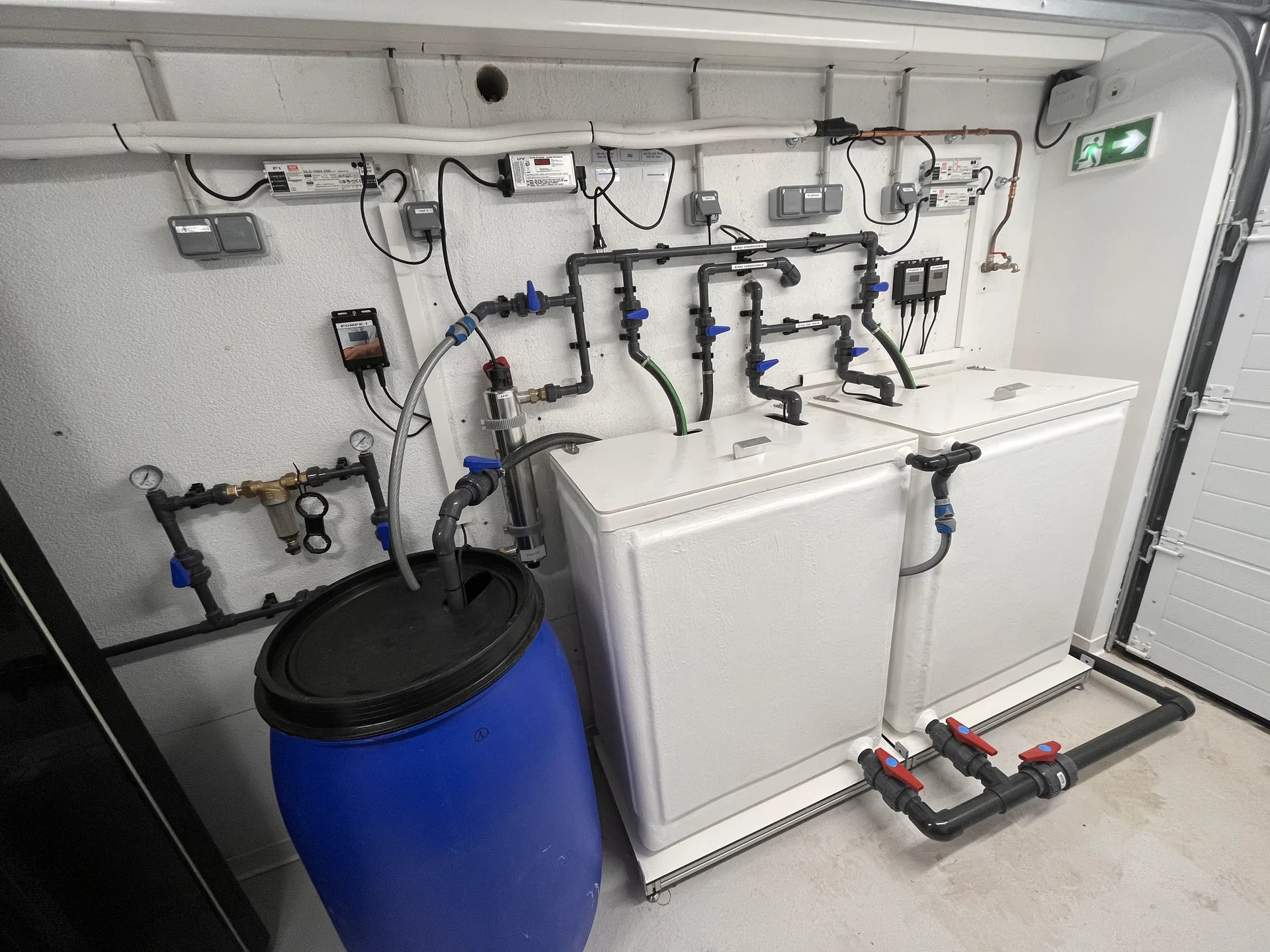
For Domiconus, in Obermorschwiller (Haut-Rhin), we designed and built a complete seawater production circuit for research — several hundred kilometres from the coast. The project captures the core of the engineering office's work: recreating and stabilising a controlled marine environment where it does not exist naturally, integrating water production, filtration and parameter regulation.
Other studies extend this expertise by sector: the complete refurbishment of an AFM (activated sand) filter for the CNRS Biological Station in Roscoff, the custom industrial live storage tanks fitted with real-time monitoring for E.Leclerc in Plérin, or the refurbishment of Océalliance's stacked live tanks in Penmarc'h. Each study starts from the same engineering principles, adapted to the species, volume and site constraints.
Independent press coverage of our work in aquaculture engineering.
Free quote · Custom study · Technical drawings